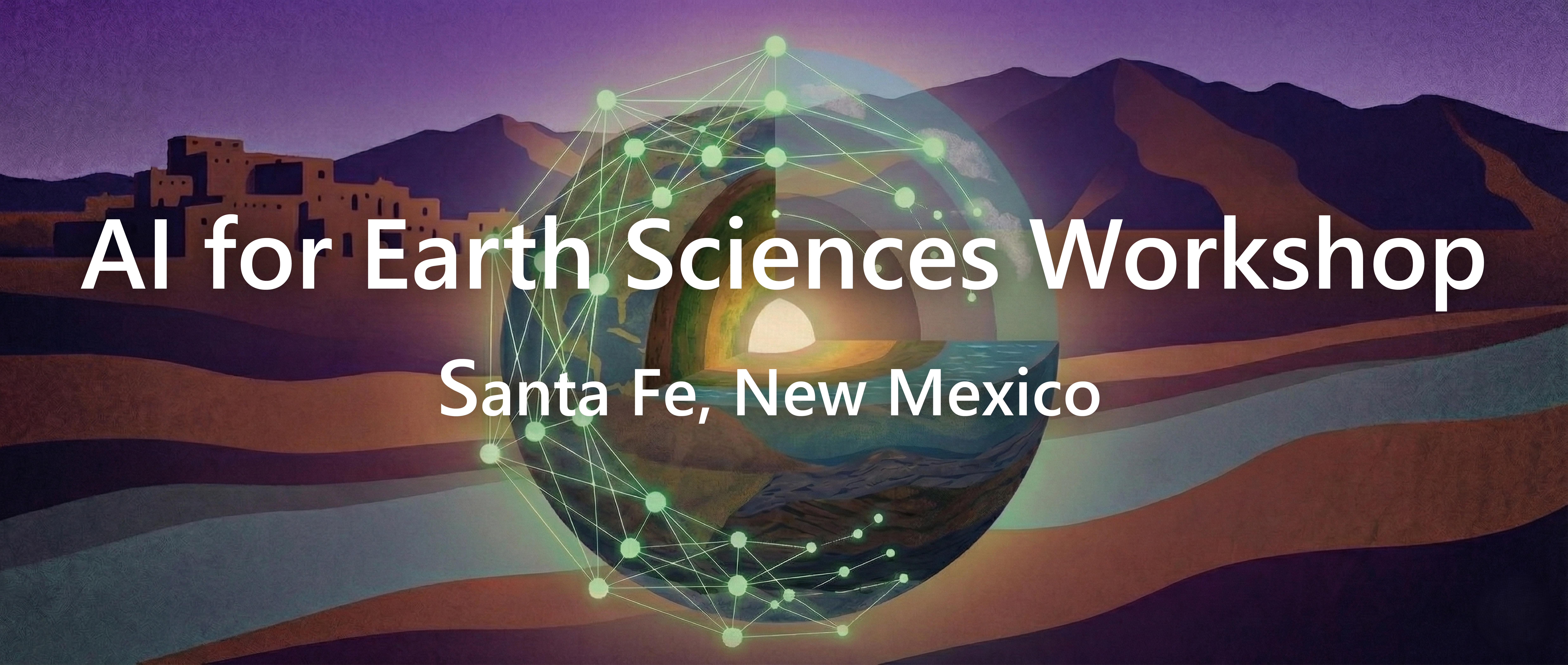
Why AI?
AI and ML, combined with physics‑informed models and curated geoscience data, are revolutionizing Earth science application for renewable energy exploration. These approaches enable faster, more accurate insights into the subsurface conditions and processes. This helps to identify and manage critical mineral resources, optimize renewable energy systems, monitor environmental impact, and make decisions to safeguard our communities and our planet.
Why Earth Science?
Earth science sits at the center of today's most urgent challenges: enabling low‑carbon energy systems, protecting water resources, securing critical minerals, and understanding our changing climate. By bringing together geoscientists, engineers, data scientists, and decision makers, this workshop focuses on how AI can deepen our understanding of the subsurface and support practical, field‑ready industrial solutions.
Why Santa Fe?
Historic Santa Fe, New Mexico sits at the crossroads of science, technology, and culture - it is home to world-class national laboratories, universities, and a thriving innovation ecosystem. This workshop unites AI and Earth Science Experts to accelerate projects which protect communities, manage resources, and advance sustainable solutions.
Over two days, participants will engage in keynotes, technical sessions, hands-on exercises, and collaborative discussion forums designed for researchers, practitioners, startups, and policymakers building the next generation of physics-informed AI tools.
At a Glance
- Dates
- March 23 – 24, 2026
- Location
- Santa Fe Community Convention Center, 201 W Marcy St, Santa Fe, NM 87501
- Registration Fee
- $150.00
- Audience
- Researchers, industry leaders,practitioners, startups, regulators
Workshop Themes
We welcome contributions showing how AI, machine learning, and high-performance computing can drive sustainable resource use, innovation, and environmental stewardship.
Physics-informed AI and hybrid modeling
Geothermal resource development
Waste management and subsurface storage
Critical minerals and rare earth exploration
Hydrogen reservoirs and underground energy storage
Groundwater quality and environmental remediation
Induced seismicity forecasting
Remote sensing and spatiotemporal analysis
Program Preview
AI Foundations for Earth Sciences
9:00 – 9:15 AM
Introduction & Welcoming Notes: The Future of AI-Enabled Earth Insights
9:15 – 10:00 AM
⭐ EnviTrace presents: Intro to AI for Earth Sciences: A Primer - Designed for beginners and non-experts
10:00 – 10:30 AM
Earthquake Dynamics from Graph Neural Networks
10:30 – 11:00 AM
Using AI/ML to Understand Arctic Snow
11:00 – 11:30 AM
Break & Mingle
11:30 AM – 12:15 PM
AI Foundation Models for Complex Tectonic Applications
12:15 – 1:45 PM
Lunch Break
1:45 – 2:30 PM
The Transparent Earth: A Multimodal Foundation Model for the Earth's Subsurface
2:30 – 3:00 PM
Solving probabilistic inverse problems with generative AI
3:00 – 3:15 PM
Break & Mingle
3:15 – 3:45 PM
Anatomy of a Seismic Time Series: Information, Prediction, and Limits on Learning
3:45 – 4:30 PM
Multilayer Perceptron Model for Predicting Conservative Solute Transport in Streams and Rivers
4:30 – 5:15 PM
Panel of Speakers
5:30 – 7:30 PM
Offsite Reception
Applied AI for Subsurface Operations
9:00 – 9:15 AM
Day 2 Introduction & Welcoming Notes: The Future of AI-Enabled Earth Insights
9:15 – 10:00 AM
From Rule Curves to Rewards: Deep Reinforcement Learning for Reservoir Management in Water-Stressed Systems
10:00 – 10:45 AM
Harnessing AI and ML to Advance Water Management
10:45 – 11:00 AM
Solving Inverse Problems with Machine Learning for Real-Time Monitoring of Subsurface Plumes
11:00 – 11:15 AM
Break & Mingle
11:15 AM – 12:00 PM
Leveraging Machine Learning for Hydrothermal Resource Assessments
12:00 – 1:30 PM
Lunch Break
1:30 – 2:00 PM
Trusting AI Models for Contaminant Plume Prediction
2:00 – 2:30 PM
Artificial Intelligence for Geophysical Subsurface Modeling: Applications to Carbon Sequestration
2:30 – 2:45 PM
Break & Mingle
2:45 – 3:15 PM
Talk TBD
3:15 – 3:30 PM
When Earthquakes Meet AI: Improving Seismic Monitoring in New Mexico
3:30 – 4:00 PM
Single-Station Earthquake Early Warning System Using Machine Learning
4:00 – 5:00 PM
Closing Round Table /Expert Panel Q&A
Call for Abstracts
We invite short abstracts (300 words max) highlighting novel AI methods, open datasets, reproducible workflows, and impact-driven applications in earth sciences. Abstracts will shape oral presentations, lightning talks, and posters across both days of the workshop. We encourage submissions that advance understanding, foster collaboration, and promote open science principles.
- •Include title, authors, affiliations, and a primary contact email.
- •Indicate preferred presentation format (oral, lightning, or poster).
- •Note any data-sharing or open-source resources associated with your work.
Submission Checklist
- Contact Information
- Primary author name, email, and institutional affiliation.
- Co-authors
- Names, emails, and affiliations for all contributing authors.
- Abstract Body
- Up to 300 words describing the challenge, methods, data, and outcomes.
- Keywords
- Choose 3–5 keywords to help us organize tracks and reviewers.
Logistics & Travel
Santa Fe is easily accessible via Albuquerque International Sunport (ABQ) with direct shuttle service to downtown. Details will be shared with confirmed attendees.
Complimentary Wi-Fi and exhibition space will be available throughout the venue. Coffee and light refreshments are provided on both days, including a Monday evening offsite cocktail hour & craft brews at The Brakeroom.
Key Dates
- Abstract Submission Deadline: March 09, 2026
- Notification of Acceptance: March 13, 2026
- Final Program Release: March 13, 2026
- Registration Deadline: March 20, 2026